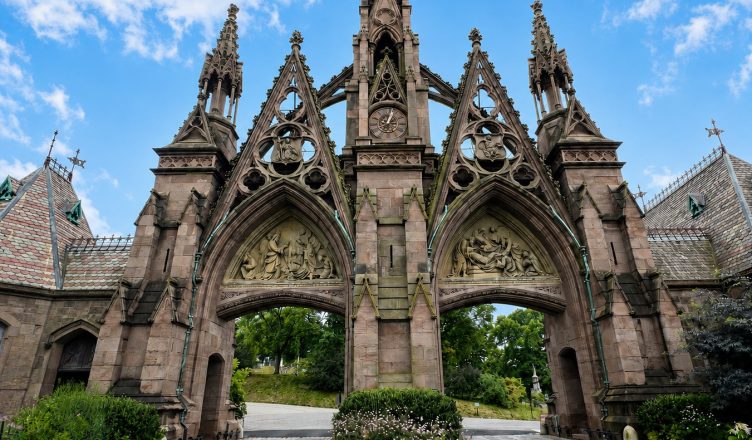
Green-Wood Cemetery is one of the most amazing cemeteries that I have ventured in to. With over a half a million graves, you can spend many, many hours and still not see all it has to offer. Green-wood covers almost 500 acres and is the nation’s second largest tourist attraction. Founded in 1838 and now a National Historic Landmark, Green-Wood was one of the first rural cemeteries in America. Also see the related post regarding the Ships of Green Wood.
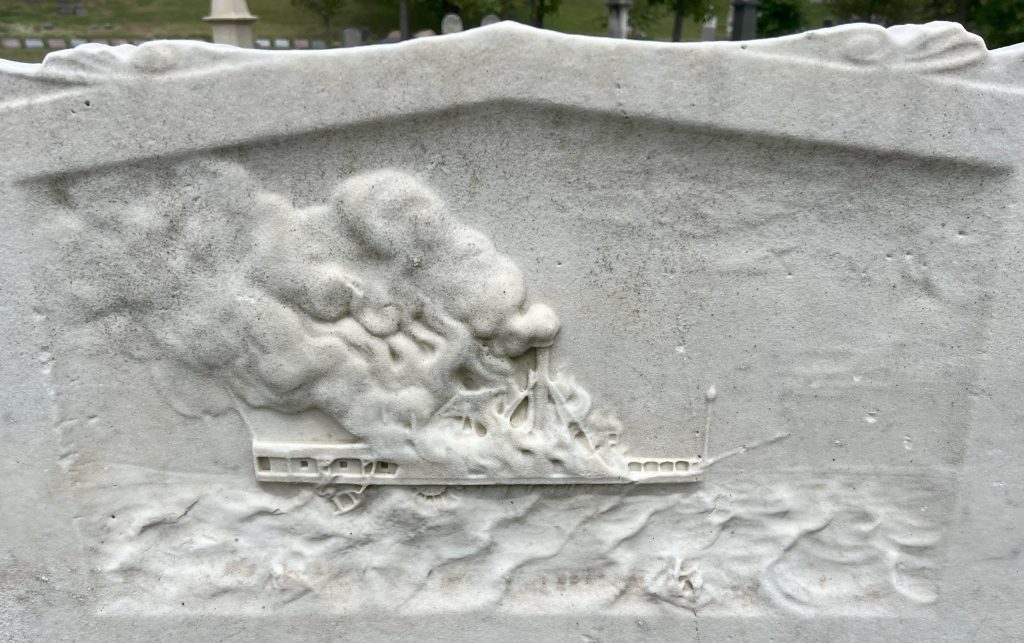
Cortland Hempstead (d. 1840),
Steamer Lexington
Over two hundred crew and passengers perished when the steamboat Lexington caught fire and ultimately sank in January of 1840. Sparks from the smoke pipe set fire to the large quantity of cotton on board. The lifeboat was thrown over, but caught the water wheel, and was lost. If you look closely at the tombstone, you will see the hanging lifeboat on the left. The captain and one other hung onto a bale of cotton for fifteen hours before being rescued. You can see on the bottom, right what appears to be people floating on a cotton bale.
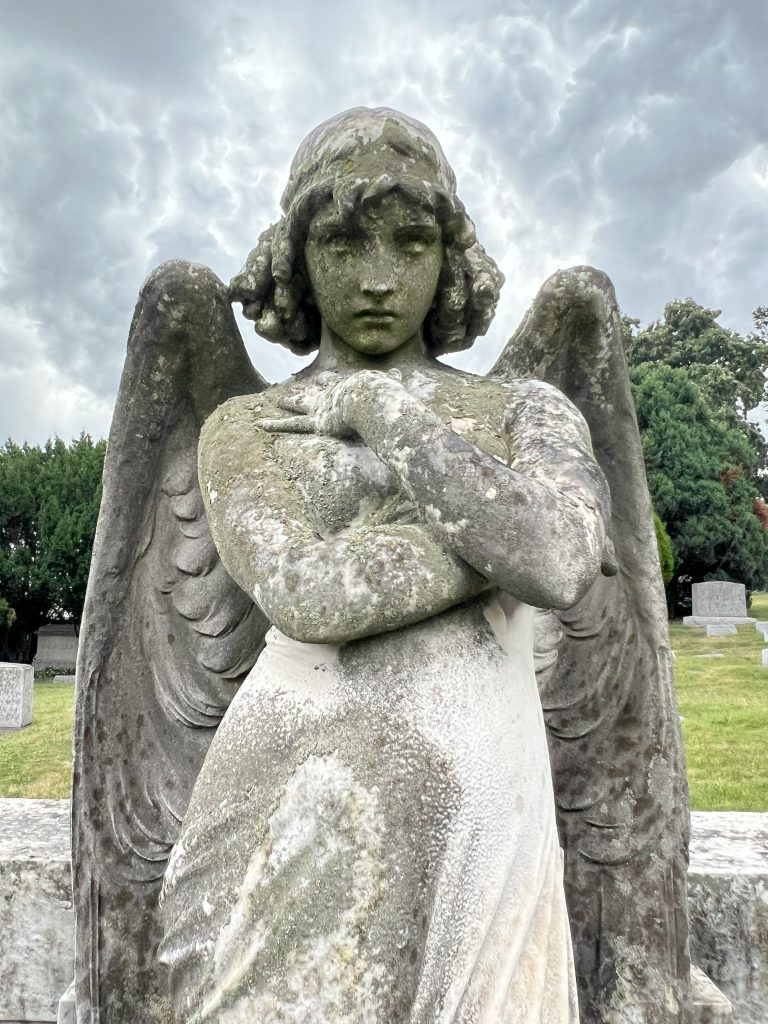
John Campbell Maben (1837–1924) and Virginia Merchant Maben (1847–1912)
The Maben angel shares a nearly identical design with the famous “Luyties Monument” in St. Louis’s Bellefontaine Cemetery. The Luyties monument is dedicated to Herman Luyties, a prominent figure in St. Louis. In the early 1900s, during a trip to Italy, Luyties fell in love with a beautiful model who posed for the sculptor Giulio Monteverde. After she rejected his marriage proposal, Luyties commissioned Monteverde to create a 12-foot marble statue of her as a token of his unrequited love. Source: Atlas Obscura.
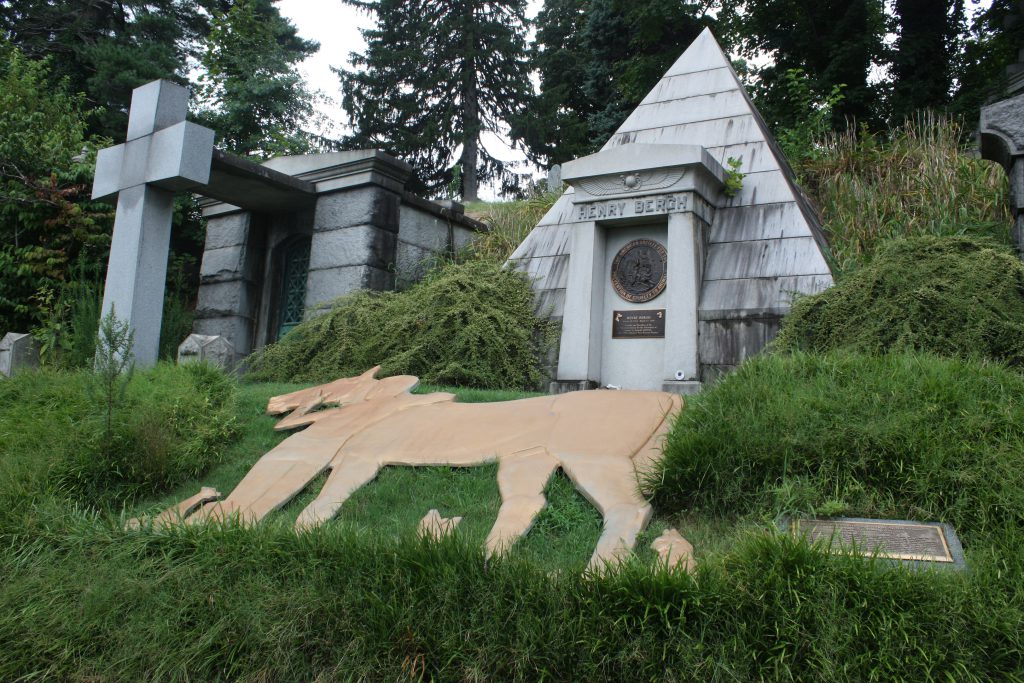
Henry Bergh (1813–1888), founder of the ASPCA, is interred in an Egyptian-style mausoleum which features a bronze sculpture dedicated to his animal welfare legacy.
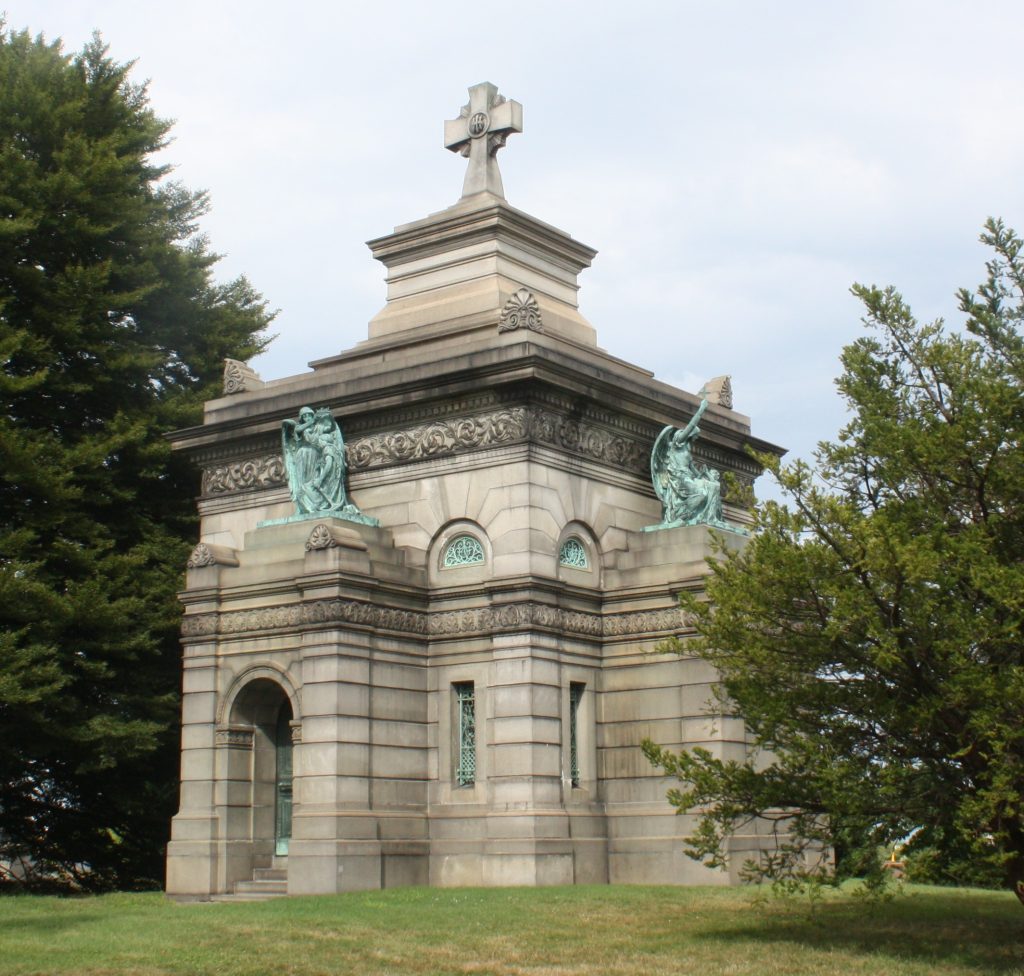
Mackay Mausoleum
According to the Courier-Journal of Louisville, Kentucky, Muldoon & Co. of Louisville, Kentucky was the builder of the Mackay mausoleum which was finished in 1898.
Each corner of the structure contains life-sized bronze sculptures representing the sorrow, faith, death, and life. The mausoleum is a miniature church auditorium with a capacity of 50. It was fitted with a heating system and electric lights that turn on only when the large bronze doors are opened.
John Mackay Jr. (1870-1895) was the first to be interred after being thrown from a horse in Paris, France. John Mackay Sr. (1831-1902), a successful mining entrepreneur, and his wife Marie Louise Hungerford (1843-1928) are also interred in the Mackay mausoleum.
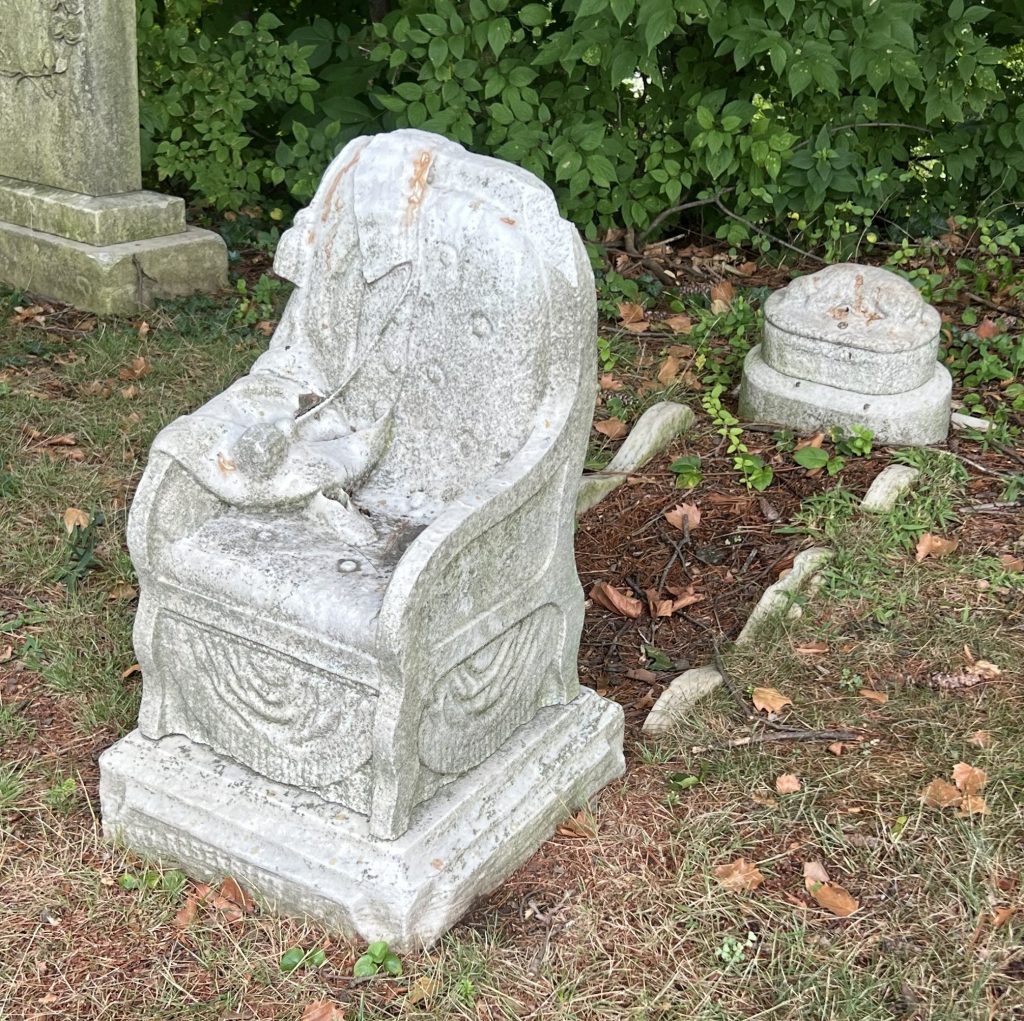
Mary Rosekrans Adsit (1868–1869)
The child’s chair with a shoe is a famous 19th-century memorial featuring an empty chair with a small shoe on the seat and a tasseled cloak draped over the side.
The empty chair, shoe, and cloak represent child mortality and the sudden loss of innocence. It suggests the child abruptly left these belongings behind. The footboard of the bed marker features a stool with a sleeping dog.
Section 22, Lot 4780
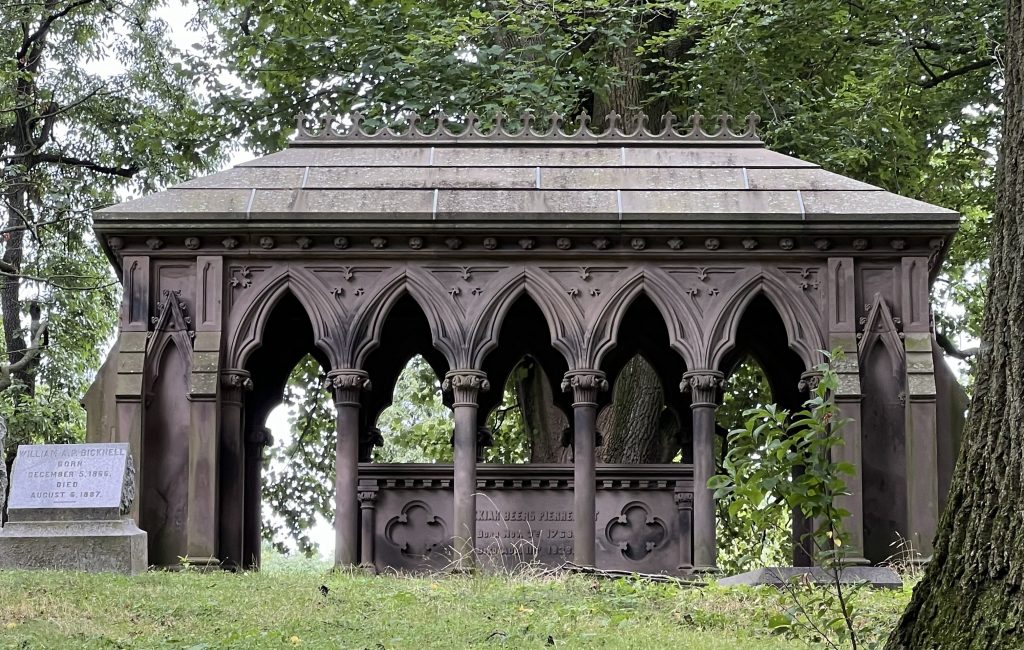
Pierrepont Family
This Gothic Revival pavilion is dedicated to Anna Maria Pierrepont and Hazekieh Beers Pierrepont. Within the pavilion a stone sarcophagus bears their names, dates of birth, and dates of death. Anna was the daughter of the Constable Family, who in the early 19th century were the largest landowners in New York State.
The monument was designed by Richard Upjohn.
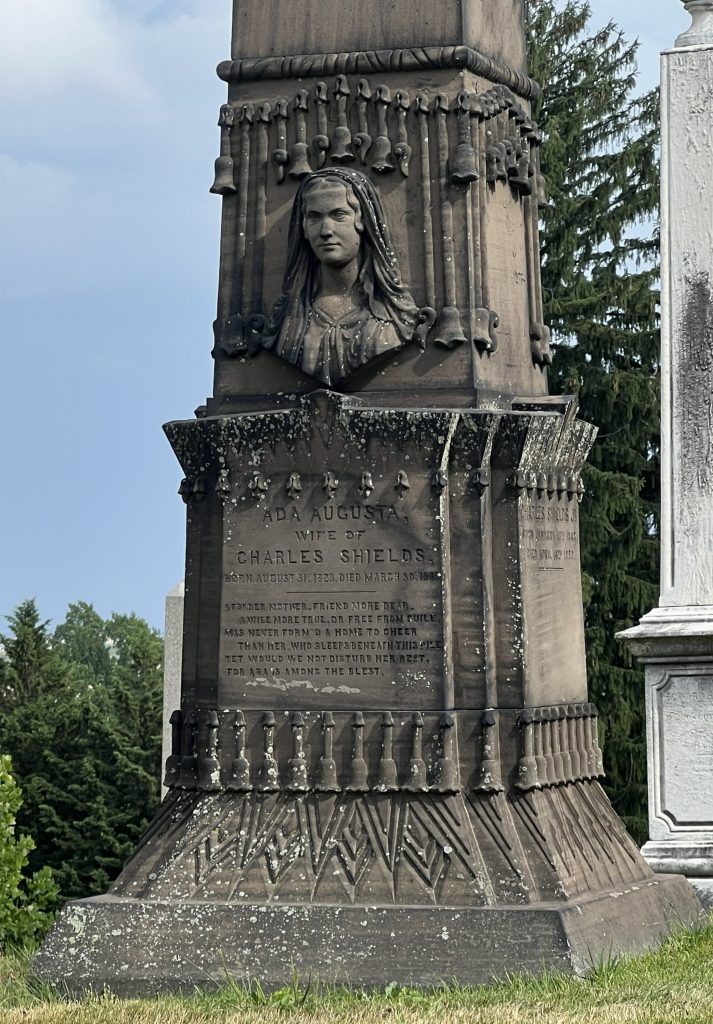
Shields Monument
Ada Augusta Bogart was born on 31 August 1823. She married Charles E. Shields about 1841, in New York.
Inscription
A fonder mother, friend more dear,
A wife more true, or free from guile
Was never formed a home to cheer
Than her who sleeps beneath this pile
Yet would we not disturb her rest,
For Ada is among the blest.
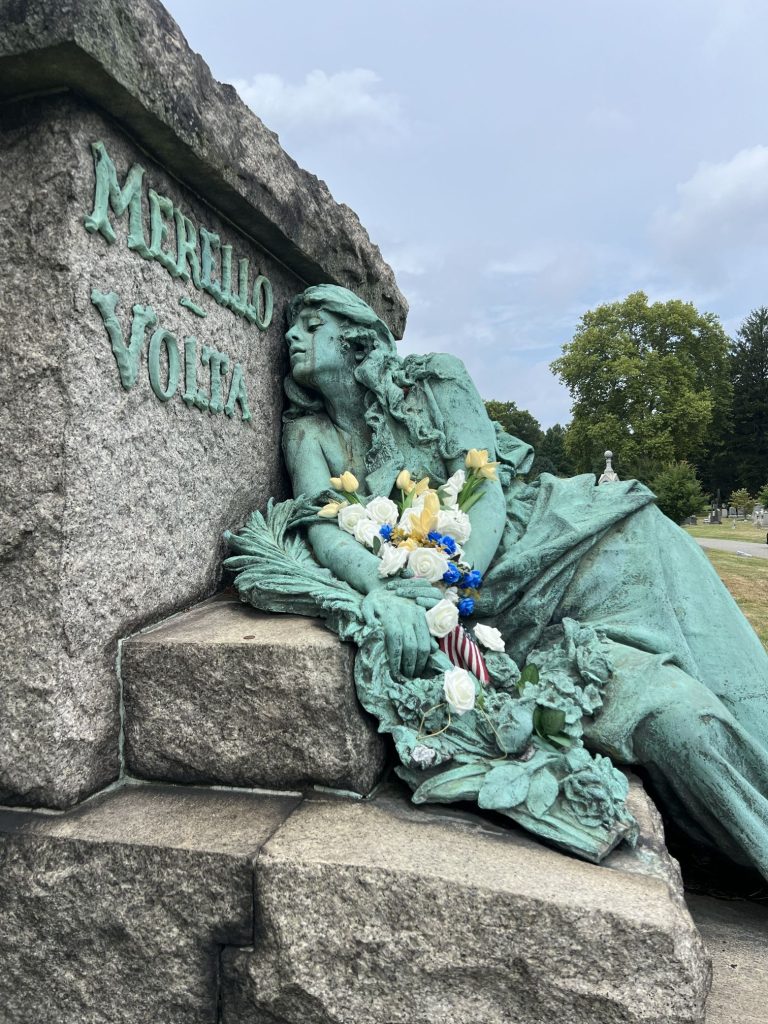
Merello Volta Mounment
Dominica Merello and her daughter, Rose Guarino, were dining with family members on the lawn of their summer home when Pietro Silverio, an irate domestic employee, rushed the women, gun in hand, to exact revenge for losing his job. As the women attempted to flee, Silverio gave chase and shot Guarino in the back. She died three days later. Source: A Mother’s Grief.
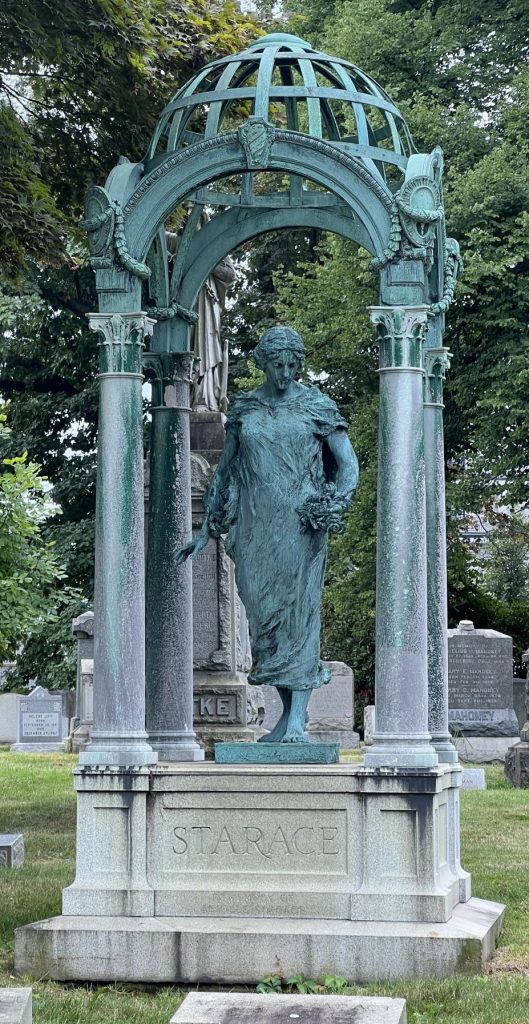
Starace Monument
The Starace family monument is located in Section 204, Lot 34542. The site marks the resting place for Giovanni Starace (1847–1917) and Lena Starace (1857-1943).
Giovanni’s obituary stated that “Giovanni Starace of the firm of Achille Starace & Co., Inc., one of the oldest members of the Produce Exchange, formerly affiliated with Funch Edye & Co., Starace Brothers, and for the last ten years connected with Hartfield Solari & Co., died yesterday morning at his home. He was born in Vico Equense, Italy, and came to this country in 1869. Mr. Starface was founder of Starace Brothers, steamship agents, was also a steamship owner and the largest stockholder of Achille Starace Funeral Company, Inc.”
While he shared a surname with Achille Starace, the infamous Fascist Party Secretary of WWII-era Italy, Giovanni Starace lived a generation earlier and operated an entirely separate American mercantile operation.
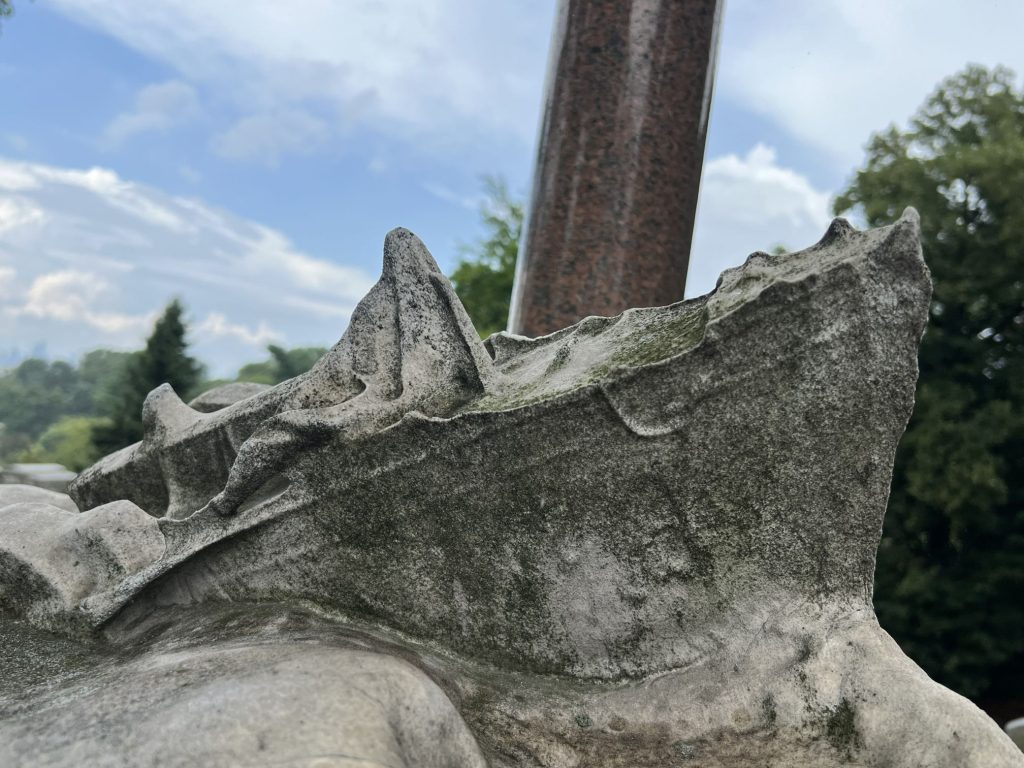
Brown Family Memorial
The Brown Family memorial commemorates lives lost on the steamer Arctic in 1854. James Brown, principal financier of the Arctic’s line, lost six family members in the disaster. The disaster triggered significant maritime reform, resulting in improved design of ocean-going ships and establishment of transoceanic mapped sea-lanes to prevent collisions between ships in the future.
The Victorian monument, with a gothic-style canopy, covers a 3D model of the sinking steamer. Sculptor John Moffit’s name is inscribed on the base.
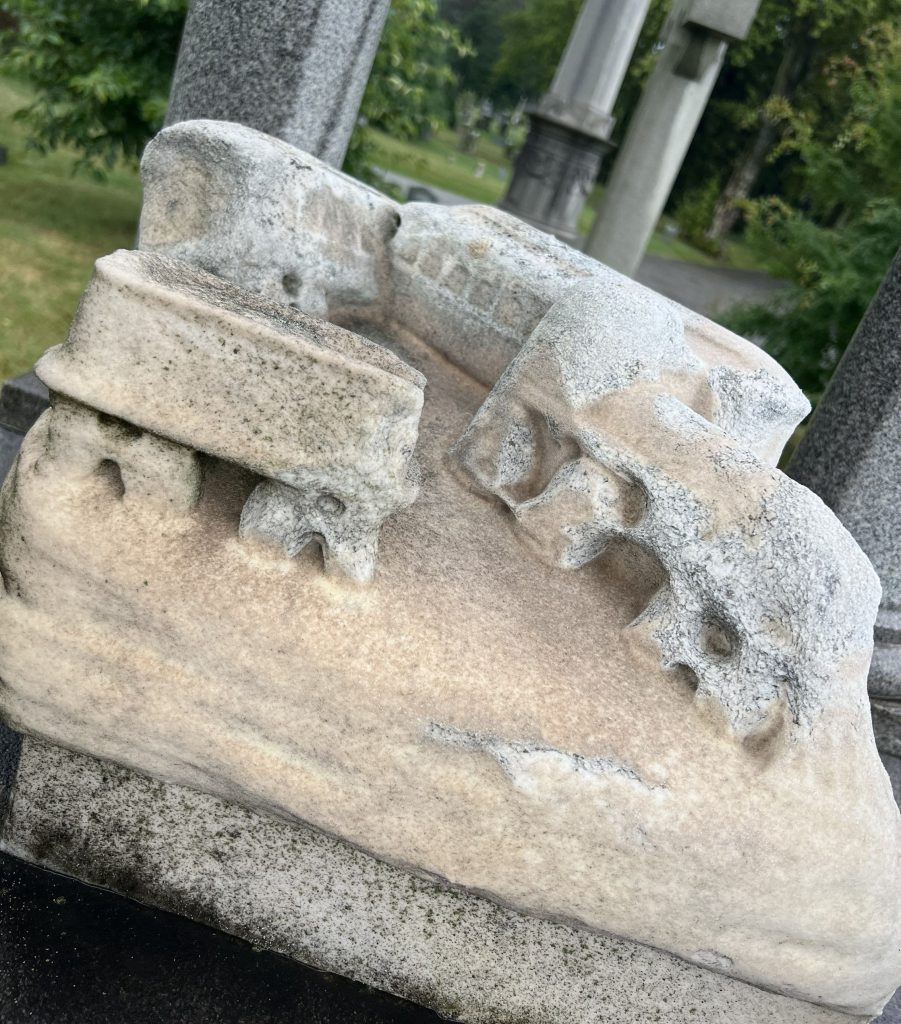
Dietzel Memorial
Oscar and Maggie Dietzel were on their way home from Manhattan Beach on August 26, 1893, when their train was struck in the rear by a Rockaway Beach train. According to the Sacramento Daily Union: “The accident, it is said, was due to the negligence of the tower man at Laurel Hill. It seems that the Manhattan Beach train was blocked at Bushwick Junction at about 11:30 o’clock, when the Rockaway Beach train, coming at a high rate of speed, ran into the tail end of the Manhattan Beach train, plowing clear through the last two cars.”
“It was frightful,” reported the New York Times. Sixteen people died because of human error. Oscar died at the hospital while his legs were being amputated. His wife of one year died at the scene. The monument was erected for Oscar and Maggie Dietzel and their three-month old daughter Laura, who predeceased them by five weeks. The monument in the Green-Wood Cemetery is a cenotaph; the Dietzels are actually buried in All Faiths Cemetery in Middle Village, New York.