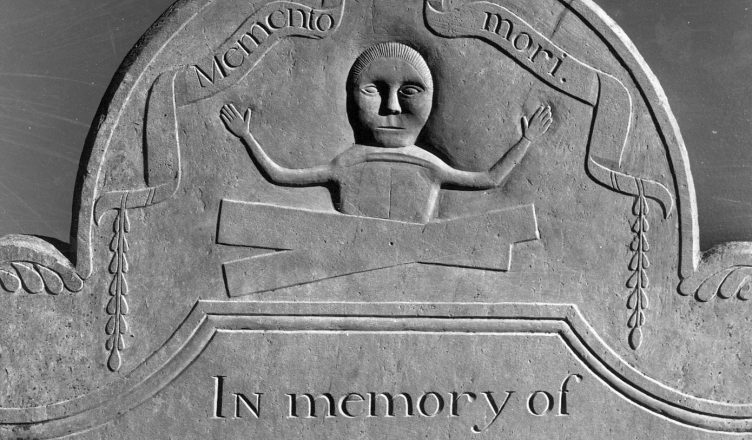
Accidents tend to be the most explicit of the Story Stone types. Why would someone feel the need to immortalize their loved one with a somewhat gruesome image of how they met their final demise? Be it a wife in flames or a child caught beneath a pile of boards—no epitaphs needed there! Certainly, there were more traditional ways to make people mindful of a shortened life. Fortunately, some gravestone carvers were quite imaginative when it came to reporting the cause of death on the tombstone!
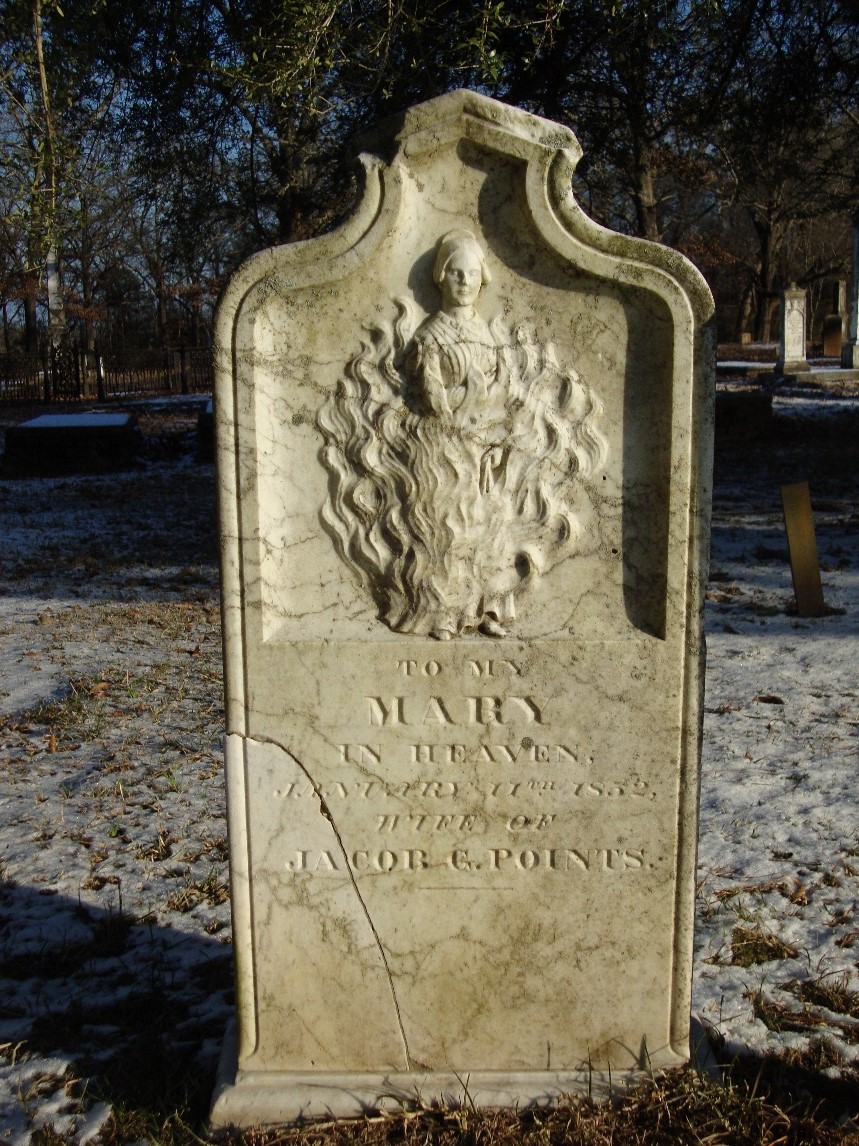
Mary in Flames
Mary Points was a victim of fashion as she died of burns received after she spilled her cologne and her crinoline dress caught fire. For whatever reason, her husband chose to memorialize her manner of death on her tombstone by depicting a woman in flames.
The Monroe Democrat reported: Aberdeen, Wednesday, January 14, 1852 – Mrs. Points – This lady – the wife of our citizen, J. J. Points – breathed her last, about 12 o’clock, on Sunday the 11th inst. – her death resulting from the effects of a severe burn, received some ten days since, and occasioned, — as in the case of Mrs. Swann of Jackson—by the overturning of a cologne bottle, the contents of which catching fire communicated to the clothes of the deceased.[i]
[i] R. Davenport, The Monroe Democrat, January 14, 1852, 4.
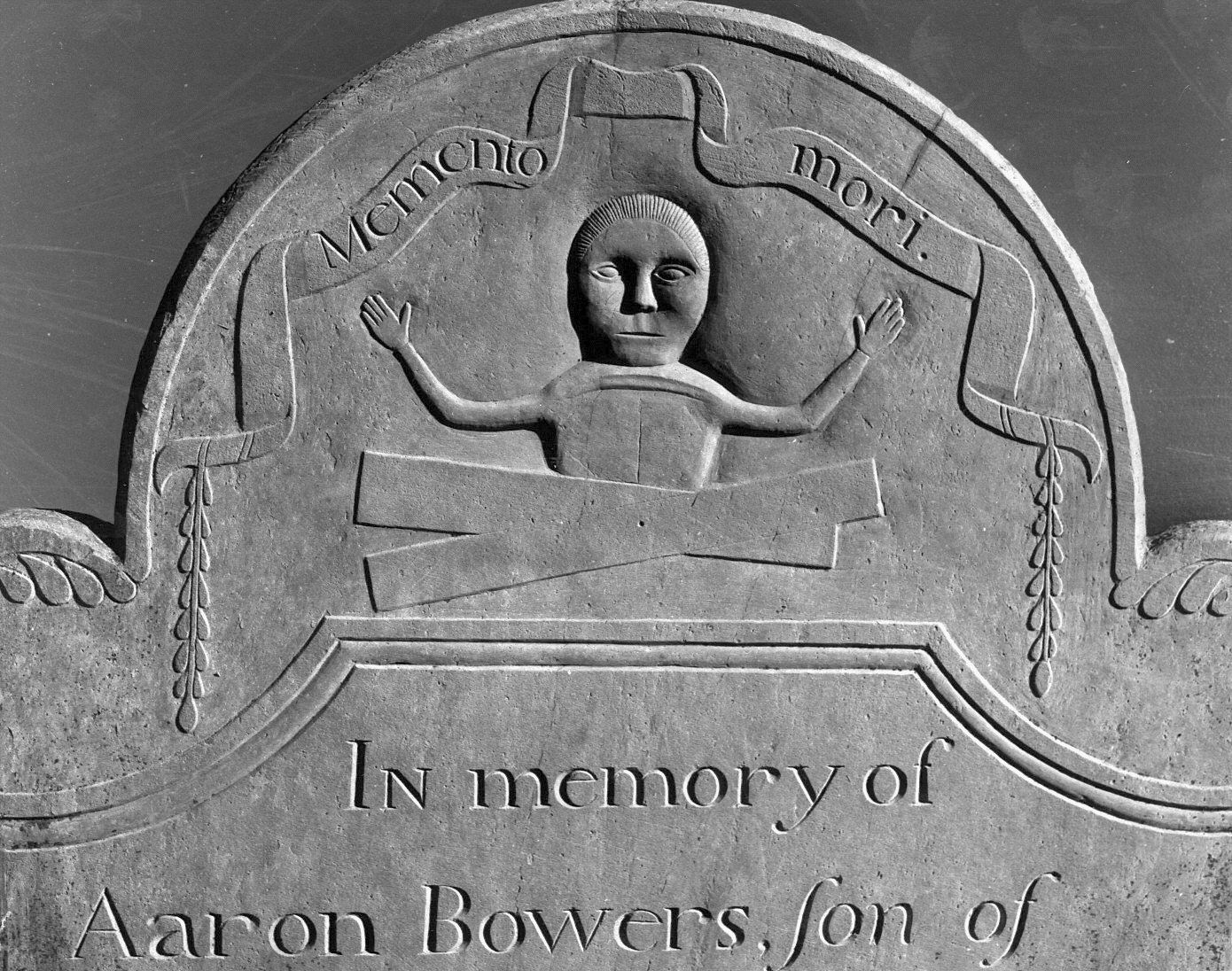
Instantly Killed by a
Stock of Boards
In memory of Aaron Bowers son of Mr John Bowers and Mrs Lydia his wife who was instantly killed by a stock of boards Sept 12 1791 Ae 2 yrs & 10 mos
The headstone of Aaron Bowers, aged two and one-half, is carved with a likeness of the boy with two planks below it, stating that he was “instantly killed by a stock of boards” in 1791. Fifteen years earlier, the Bowers family lost three-year-old John who was “drowned in a tan pit.” [i]
[i] John O’Keefe, “200-year-old Gravestones…,” The Lowell Sun, August 1, 1971, 51.
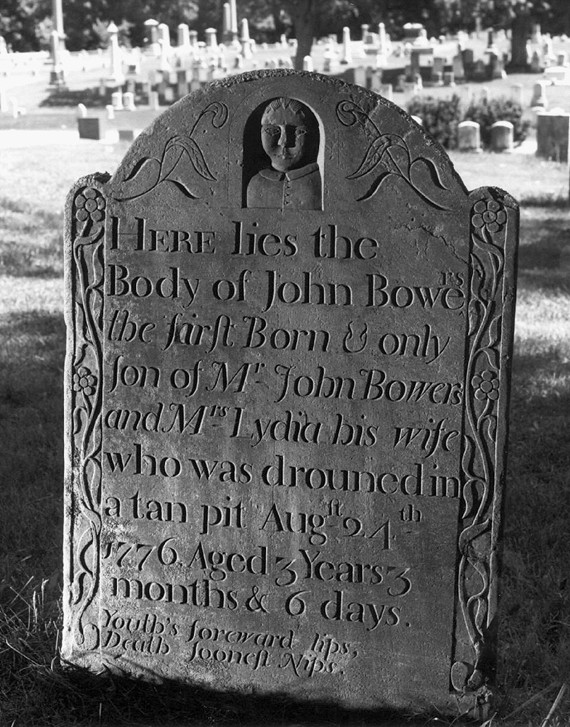
Drowned in a Tan Pit
Here lies the Body of John Bowers the first Born & only son of Mr John Bower and Mrs Lydia his wife who was drouned in a tan pit Augst 24th 1776 aged 3 Years 3 months & 6 days.
Youth’s foreward lips, Death soonest Nips.
Three-year old John Bowers met an unpleasant end when he fell into a vat sunk into the ground for tanning leather. If he didn’t drown first, then the toxic chemicals certainly would have caused his final demise.
Fell on a Stick
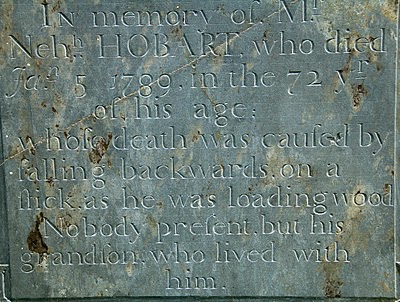
Nehemiah Hobart, a Revolutionary war patriot, “whose death was caused by falling backwards on a stick as he was loading wood. Nobody present but his grandson who lived with him.” A kind husband, a tender parent, a trusty friend, respectable in his day, his death remarcable!
Excerpt from an old blank book once owned by Caleb Hobart, a son of Nehemiah:
“Nehemiah the 2nd [son of “Shebuel”] Born in Groton March 1717 and Died in Pepperrell January 5th 1789 Whose Death was caused by a fall as he was out after wood as he was about loding [logging] he fell Backwards acros a Stick of wood which Struck the breth out of his body he Expired instantly Nobody present but a Grand Son who lived with him about 11 years old Shocking to all: We ought So to Improve Such Seens as to be reddy for we k[n]ow not how Soon or Sudde[n]ly we may be Called.” [i]
[i] “Hobart Records”, The New England Historical and Genealogical Register. (Boston: New England Historic Genealogical Society) 85:441.
Dung Fork Tine to the Brain
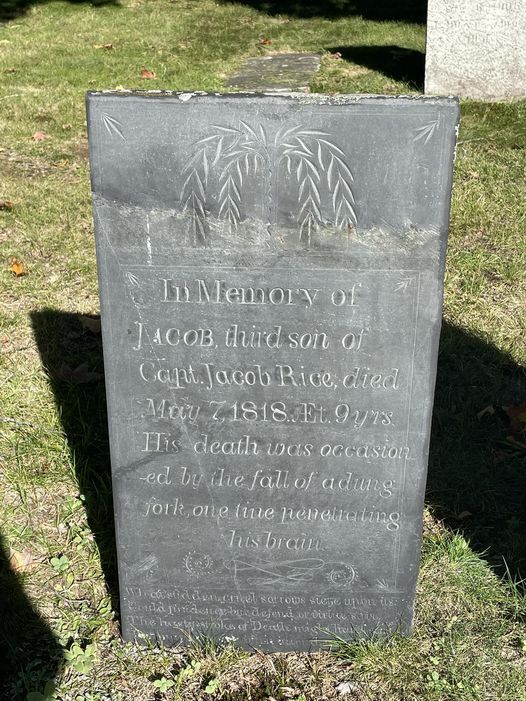
Nine-year old Jacob Rice, was “Killed by the fall of a dung fork, one tine penetrating his brain.” Rice’s death is a grim reminder of life’s unpredictability, where even the most mundane tools could lead to unforeseen calamities.
It seems that farming is still a dangerous occupation as at present each year, more people die while farming than while serving as police officers, firefighters or other emergency responders. The U.S. Bureau of Labor Statistics reports a rate of 23 work-related deaths per 100,000 workers in the agricultural industry. That is seven times higher than the national average for workers.[i]
[i] Linda Geist, Farming: The most dangerous job in the U.S., University of Missouri Extension, https://extension.missouri.edu/news/farming-the-most-dangerous-job-in-the-us
Fell From a Common Chair
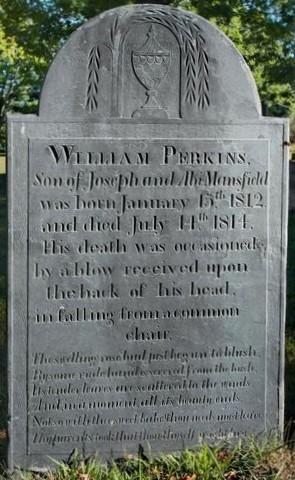
Two-year old William Perkins Mansfield’s “death was occasioned by a blow received upon the back of his head in falling from a common chair.” William’s father, Dr. Joseph Mansfield, a Harvard graduate also shares a tragic story as reported by John Moulton: “While bathing near Chase’s mill he was seized with the cramp in his limbs and so disabled that he could not reach the shore and when found by his companions, who were at work, haying, on the mash nearby, was supposed to be drowned; but by the application of the proper means he was resuscitated and taken home, but did not regain consciousness for some days. Then, awakening from sleep, he suddenly exclaimed, ‘Mother, where have I been?’ He seemed to have lost what knowledge he had acquired, and his mind was like that of a child, so that it was necessary for him to begin and learn his letters as he had done as a boy.” [i]
[i] Joseph Mansfield, FindAGrave.com, https://www.findagrave.com/memorial/142213626/joseph-mansfield
Kill’d by a Fall on a Scythe Crofs Y Bally
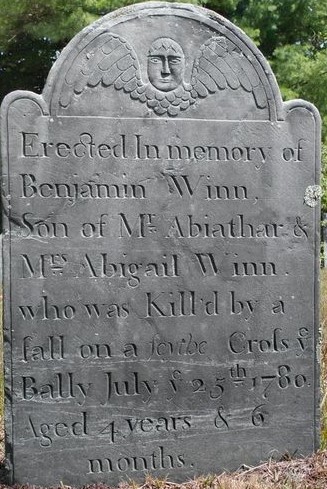
In another tragic farm accident, four-year old Benjamin Winn, d. 25 July 1780, was “Kill’d by a fall on a scythe Crofs Y Bally.” Young Benjamin literally succumbed to the tool of the grim reaper—the scythe which is often the symbol of death. Micajah, his brother, drowned at the age of nineteen, is buried next to Benjamin in the Blodgett Cemetery along with his three-year-old sister Sarah.
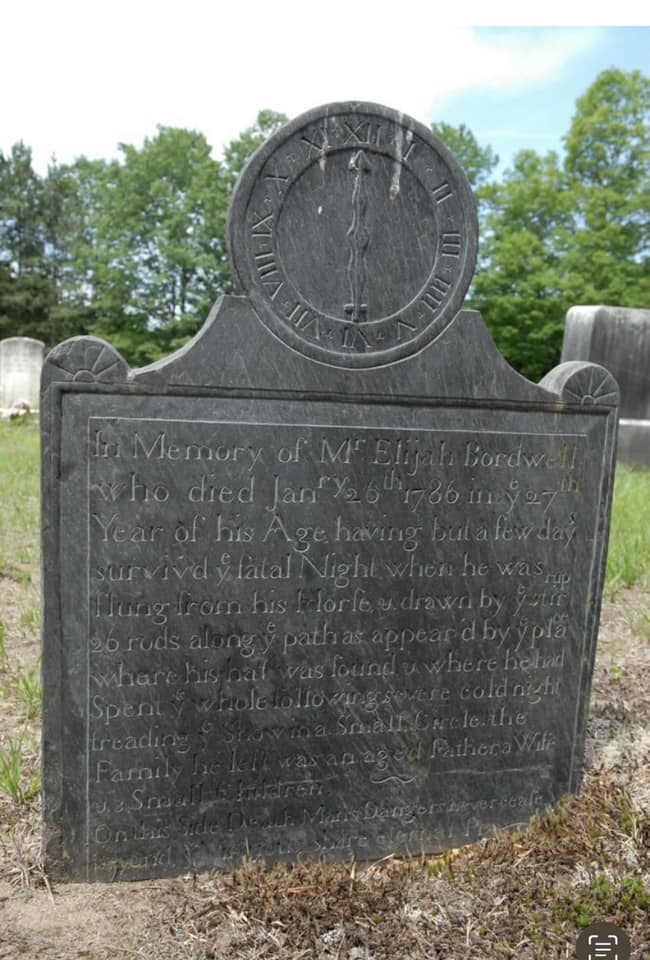
Horse in Circles
The clock stopped at 12:30 was a grim marker for the dark end of Elijah Bordwell’s journey.
In Memory of Mr. Elijah Bordwell who died Jany 26th, 1786 in ye 27th year of his age, having but a few days survived ye fatal night when he was flung from his horse and drawn by ye stirrup 26 rods along ye path as appear’d by ye place where his hat was found, and where he had spent ye whole following severe cold night treading ye snow in small circle. The family he left was an aged Father, a Wife and 3 small children. On this side death man’s dangers never cease/Beyond ye virtuous share eternal peace.
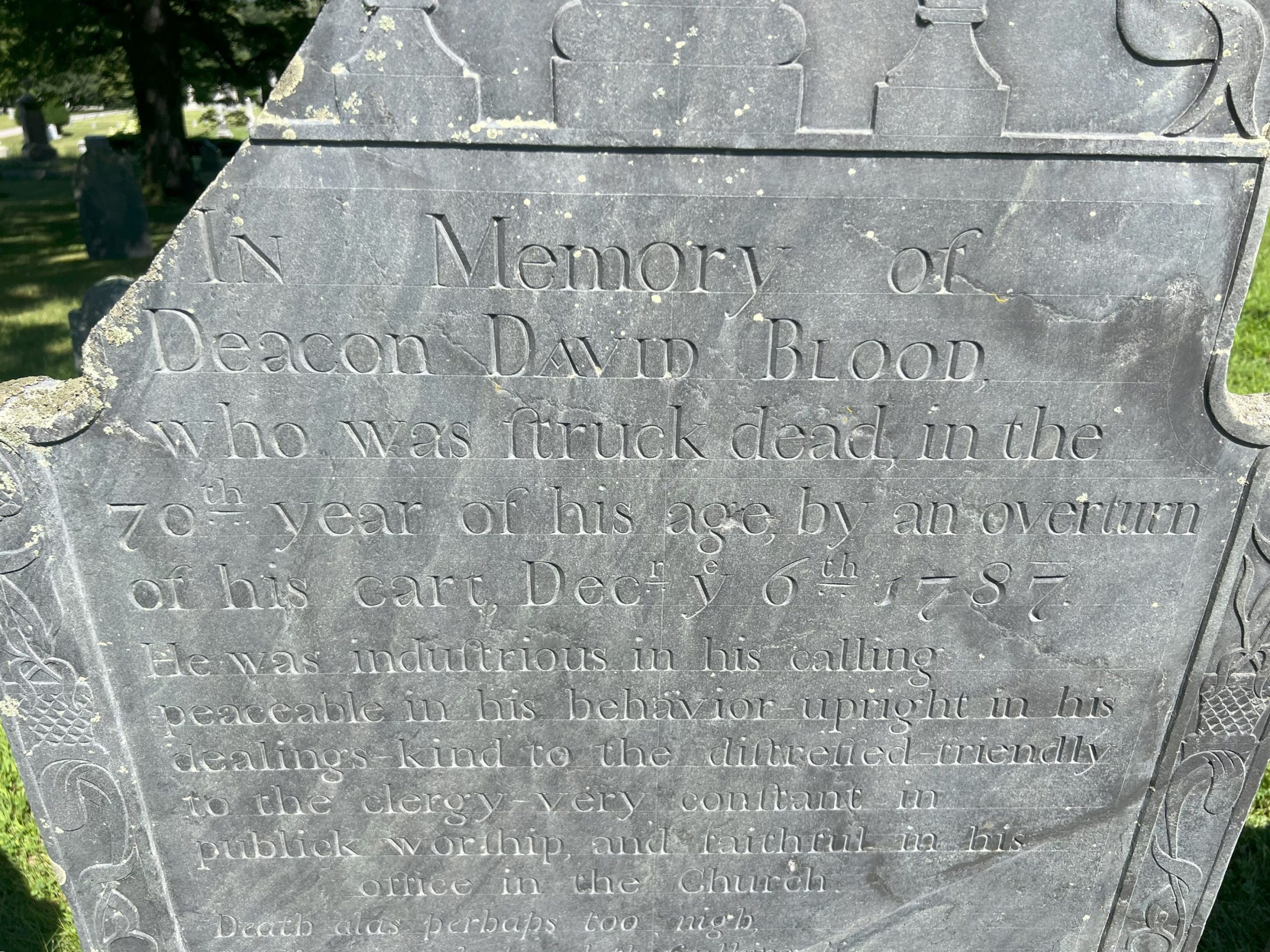
Killed by His Cart
Deacon David Blood died at the age of 70 when his cart overturned. His poetic epitaph concludes with a reminder of death’s inevitably, stopping us in our “airy dream to part” without warning.
IN Memory of
Deacon DAVID BLOOD
who was struck dead in the
70th year of his age, by an overturn
of his cart, Decr. ye 6th 1787.
He was industrious in his calling
peaceable in his behavior upright in his
dealings kind to the distressed friendly
to the clergy very constant in
publick worship, and faithful in his
office in the Church.
Death alas perhaps too nigh,
In the next hedge doth sculking lie;
There plants his engines thence lets fly his dart:
Which while we ramble without fear
Will stop us in our full career,
And force us from our airy dream to part.
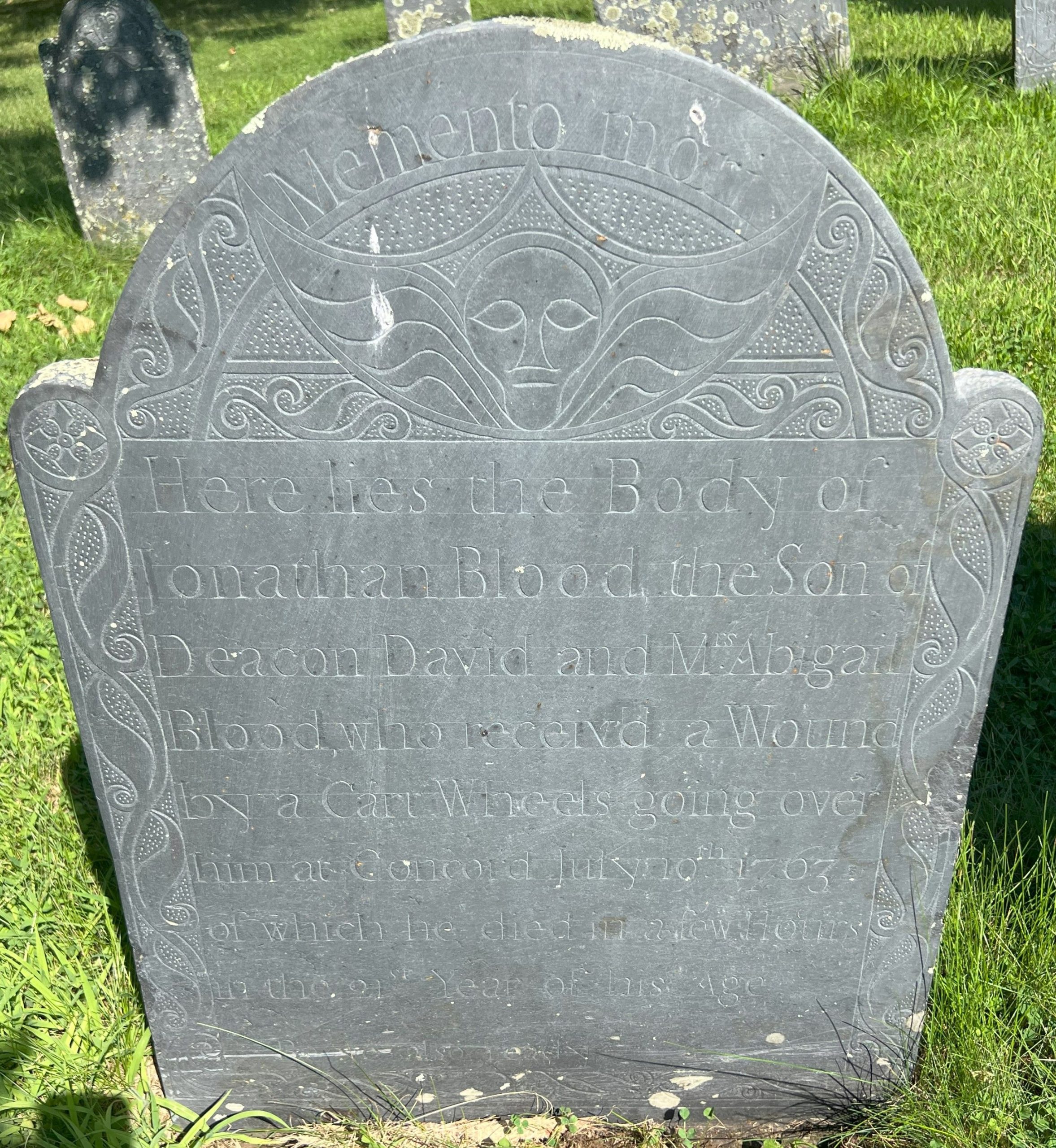
Killed by a Cart Wheels
Deacon David Blood’s second son Jonathan, also in Walton Cemetery, “received a wound by a cart wheels going over him at Concord July 10th 1763 of which he died in a few hours” when he was 21 years old. Jonathan’s brother’s wife Keziah was not allowed to be buried in the cemetery as she died from Small pox at the age of 91, when there was a great fear of the disease. The NS-DAR Prudence Wright Chapter erected a roadside memorial in her honor. [i], [ii]
[i] Roger Deane Harris, “The Story of the Bloods,” G.K. Hall & Co., Sanbornville, New Hampshire, United States: 1960, entry C159, p.176. Available online at The Internet Archive, https://archive.org/details/storyofbloodsinc00unse
[ii] Keziah Jewett Blood, FindAGrave.com, https://www.findagrave.com/memorial/147106398/keziah-blood